


What Texture and Flavor Can You Expect from Mochi Waffles Made with Mochi Waffle Mix?
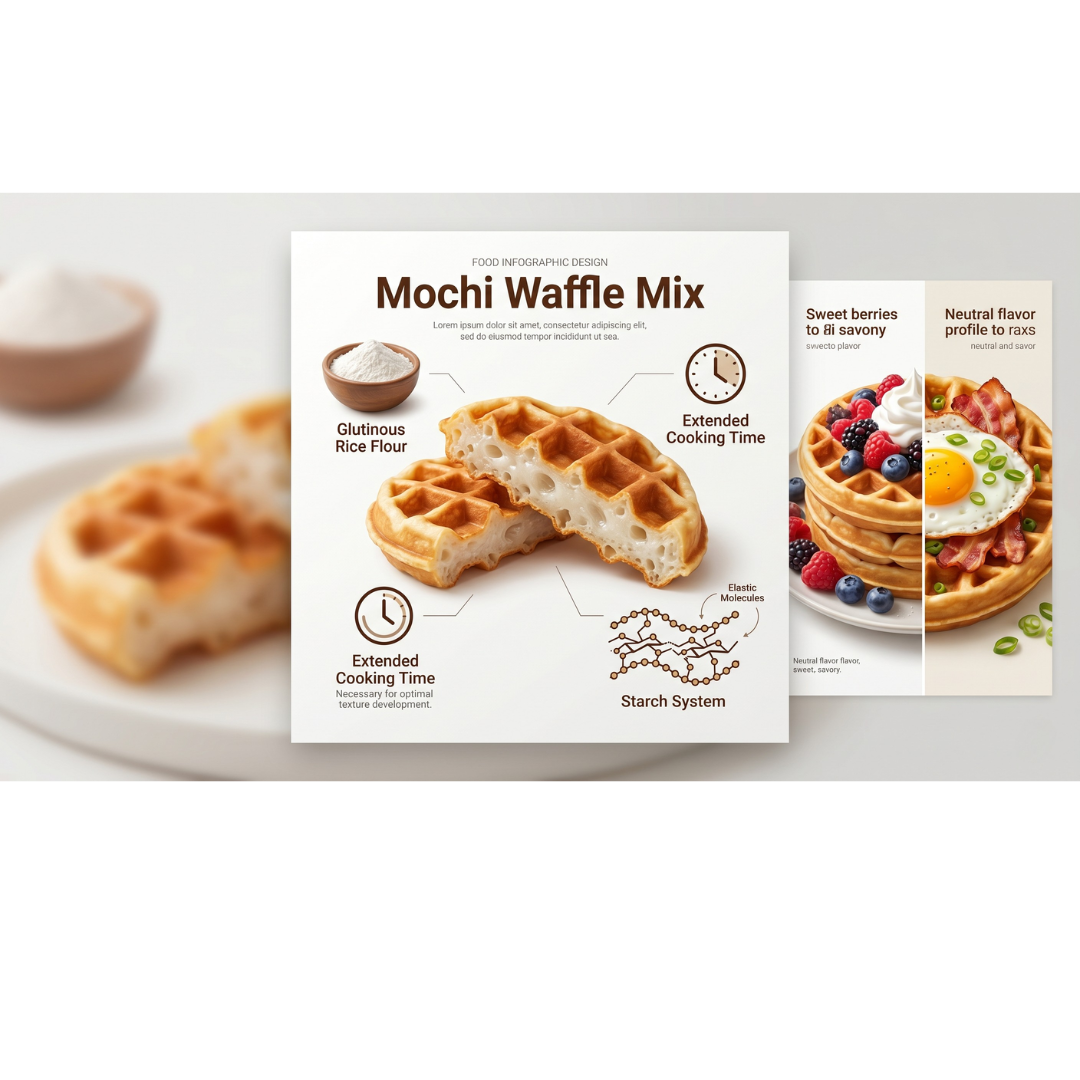
Texture drives product decisions in commercial baking. Mochi waffles stand apart because their structure and bite differ clearly from wheat based waffles. This article explains how they behave in production, what defines their texture and flavor, and where they fit in professional menus.
Texture Characteristics in Mochi Waffles
Mochi waffles are defined by a contrast between surface crispness and internal chew. This is not incidental. It comes from starch systems that respond differently to heat compared to wheat flour.
Key texture attributes:
-
Outer layer forms a thin, crisp crust with even browning
-
Interior remains dense, moist, and elastic
-
Bite has noticeable resistance with a slight pull
-
Structure holds after cooling without turning dry
The crumb is compact rather than airy. Gas retention is limited, so the final product does not expand like a standard waffle. This gives a consistent shape and a stable eating experience across service formats.
For plated desserts and display counters, this structure helps maintain visual form over time.
Flavor Profile and Base Characteristics
Flavor profile:
-
Mild sweetness
-
Light grain note with a rice like character
-
Balanced richness depending on formulation
-
Clean finish with minimal aftertaste
In commercial formulations, supporting ingredients such as milk solids and sugar contribute to browning and balance. The base does not compete with toppings, which is useful for both sweet and savory menu formats.
Role of Starch Systems in Texture Formation
The defining texture comes from amylopectin rich starch. This type of starch absorbs water and forms an elastic network when heated.
In commercial mixes, this structure is supported by:
-
Glutinous rice flour or similar starch sources
-
Modified starch for consistency across batches
-
Emulsifiers to support texture stability
-
Milk solids for color and flavor balance
Impact on batter and cooking:
-
Batter is thicker and flows slowly
-
Cooking time is slightly longer than standard waffles
-
Interior remains flexible after cooking instead of brittle
Temperature control is important. Insufficient cooking leaves the center under set. Excess heat reduces chew and dries the crumb.
Production Behavior in Commercial Environments
Understanding production behavior helps reduce variation across batches. Mochi waffle batter reacts differently during mixing and cooking.
Key considerations:
-
Allow short resting time for full hydration
-
Maintain consistent batter ratios across batches
-
Avoid over mixing to prevent texture changes
-
Use consistent equipment settings across stations
Cooking cycles may need adjustment depending on the waffle iron design. A stable process leads to repeatable texture and color.
Where Mochi Waffles Fit in Professional Menus
Mochi waffles perform well where texture contrast adds value to the product.
Suitable applications:
-
Dessert menus where structure and plating matter
-
Grab and go counters requiring shape retention after cooling
-
Café formats with fusion or Asian inspired items
-
Hotel brunch spreads offering variation from standard waffles
-
Retail bakery displays where product differentiation drives attention
Less suitable scenarios:
-
High speed service lines with strict time constraints
-
Menus focused on light and airy waffle textures
-
Operations without flexibility in cooking time adjustments
Placement should match both service style and customer expectation.
Batch Consistency and Scaling
Consistency is a priority in large scale production. The chew and crust formation must remain uniform across output.
Standardization points:
-
Fixed liquid ratios
-
Defined resting time
-
Controlled cooking duration and temperature
Operational tips:
-
Test batches when introducing new equipment
-
Keep process steps uniform across teams
-
Monitor color and texture during peak service
A controlled process reduces variation and keeps product quality stable across service periods.
Conclusion
Mochi waffles offer a clear alternative to classic Belgian-style waffles through their dense crumb and elastic bite. The texture comes from starch behavior rather than aeration, and the flavor remains neutral to support different menu formats.
For commercial operations, the value lies in consistency, structural stability, and the ability to fit into waffle menus available in hotels, QSRs, and all-day diners. Correct process control and menu placement are key to getting reliable results.
Frequently Asked Questions
Do mochi waffles require different cooking settings?
Yes. They typically need slightly longer cooking time to fully set the interior while maintaining surface crispness. However, always follow the manufacturer’s instructions for the same.
Can mochi waffles hold quality after cooling?
Yes. Their structure remains stable and does not dry out quickly, which suits display and grab-and-go formats.
How does the flavor affect menu pairing?
If the mild base flavor is neutral, it allows both sweet and savory toppings to stand out without interference.
Are mochi waffles suitable for high-volume production?
Yes, if batter ratios, resting time, and cooking parameters are controlled consistently across batches. That’s why professional-grade mochi waffle mix becomes a reliable solution.

 English
 Arabic
 French
 Spanish
 Portuguese
 Deutsch
 Turkish
 Italiano
 Russian
 Romaian
 Portuguese (Brazil)
 Greek
Greek
