


Black Box Testing and White Box Testing: Pros, Cons, and Use Cases
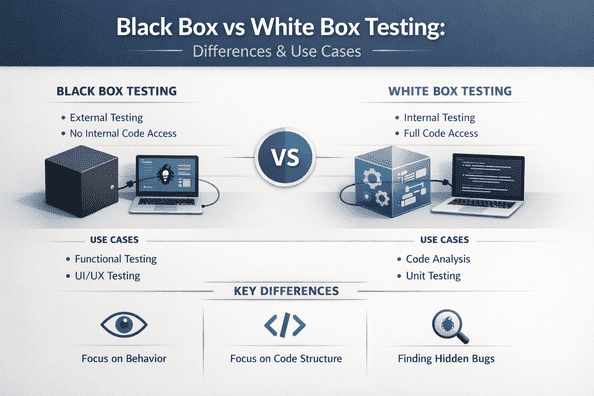
In modern software development, ensuring quality requires multiple testing approaches. Among the most fundamental are black box testing and white box testing. While both aim to identify defects and improve reliability, they differ significantly in their approach, scope, and application.
Understanding the strengths and limitations of each helps teams choose the right strategy for different testing scenarios.
What Is Black Box Testing?
Black box testing focuses on validating software functionality without any knowledge of its internal code or structure. Testers interact with the system as end users, providing inputs and verifying outputs.
Key Characteristics
- No visibility into internal code
- Focuses on functionality and user behavior
- Based on requirements and specifications
- Commonly used in system and acceptance testing
Example
Testing a login feature by entering valid and invalid credentials and verifying whether access is granted or denied.
What Is White Box Testing?
White box testing involves testing the internal structure, logic, and code of an application. It requires knowledge of the codebase and is typically performed by developers.
Key Characteristics
- Full visibility into code and logic
- Focuses on internal implementation
- Validates code paths, conditions, and loops
- Commonly used in unit and integration testing
Example
Testing whether all branches of a function are executed correctly, including edge cases and error handling.
Key Differences Between Black Box Testing and White Box Testing
Approach
- Black box testing focuses on inputs and outputs
- White box testing focuses on internal logic and code
Knowledge Requirement
- Black box testing does not require coding knowledge
- White box testing requires understanding of the code
Scope
- Black box testing covers functional behavior
- White box testing covers code-level validation
Execution
- Black box testing is often performed by QA testers
- White box testing is typically performed by developers
These differences highlight how black box testing and white box testing addresses different aspects of software quality.
Pros and Cons of Black Box Testing
Advantages
User-focused validation
Ensures that the application behaves as expected from a user’s perspective.
No coding knowledge required
Accessible to testers without programming expertise.
Effective for functional testing
Validates business requirements and workflows.
Limitations
Limited coverage of internal logic
Cannot detect issues in code structure or hidden paths.
Dependent on test case quality
Missed scenarios can lead to undetected defects.
Less effective for complex logic validation
Does not verify internal conditions or algorithms.
Pros and Cons of White Box Testing
Advantages
Thorough code coverage
Ensures all code paths and conditions are tested.
Early defect detection
Identifies issues during development before integration.
Improves code quality
Encourages better coding practices and structure.
Limitations
Requires technical expertise
Not suitable for non-technical testers.
Time-consuming for large systems
Testing every code path can be complex.
Limited user perspective
Does not validate real-world user behavior.
Use Cases for Black Box Testing
Black box testing is best suited for scenarios where functionality and user experience are the primary focus.
Common use cases include:
- Functional testing of features
- System testing of complete applications
- User acceptance testing
- API testing from an external perspective
For example, validating an e-commerce checkout flow ensures that users can complete purchases successfully.
Use Cases for White Box Testing
White box testing is ideal for validating the internal correctness of the application.
Common use cases include:
- Unit testing of individual functions
- Code validation during development
- Testing complex algorithms
- Ensuring proper error handling and logic execution
For instance, verifying the correctness of a pricing algorithm ensures accurate calculations across different scenarios.
How They Work Together
Rather than choosing between black box testing and white box testing, most teams use both approaches together.
A combined strategy provides:
- Functional validation through black box testing
- Code-level accuracy through white box testing
- Better overall test coverage
- Reduced risk of defects
For example, developers may write white box tests to validate logic, while QA teams use black box testing to ensure the application works as expected for users.
Choosing the Right Approach
The choice between these approaches depends on:
- Testing goals
- Application complexity
- Team expertise
- Stage of development
In practice:
- Use white box testing during development for code validation
- Use black box testing during later stages for functional validation
Combining both ensures a balanced and effective testing strategy.
Common Mistakes to Avoid
- Relying solely on one testing approach
- Ignoring user experience while focusing only on code
- Skipping code-level validation
- Not aligning testing strategy with project requirements
Avoiding these mistakes helps teams achieve better quality outcomes.
Conclusion
Black box testing and white box testing are both essential for building high-quality software. While black box testing ensures that applications meet user expectations, white box testing verifies the correctness of the underlying code.
By understanding their pros, cons, and use cases, teams can apply each approach effectively and create a comprehensive testing strategy that delivers reliable and robust software.

 English
 Arabic
 Spanish
 Portuguese
 Deutsch
 Turkish
 Dutch
Dutch
 Italiano
 Russian
 Romaian
 Portuguese (Brazil)
 Greek
Greek
