


What Makes Graphene Oxide Ideal for Coatings?
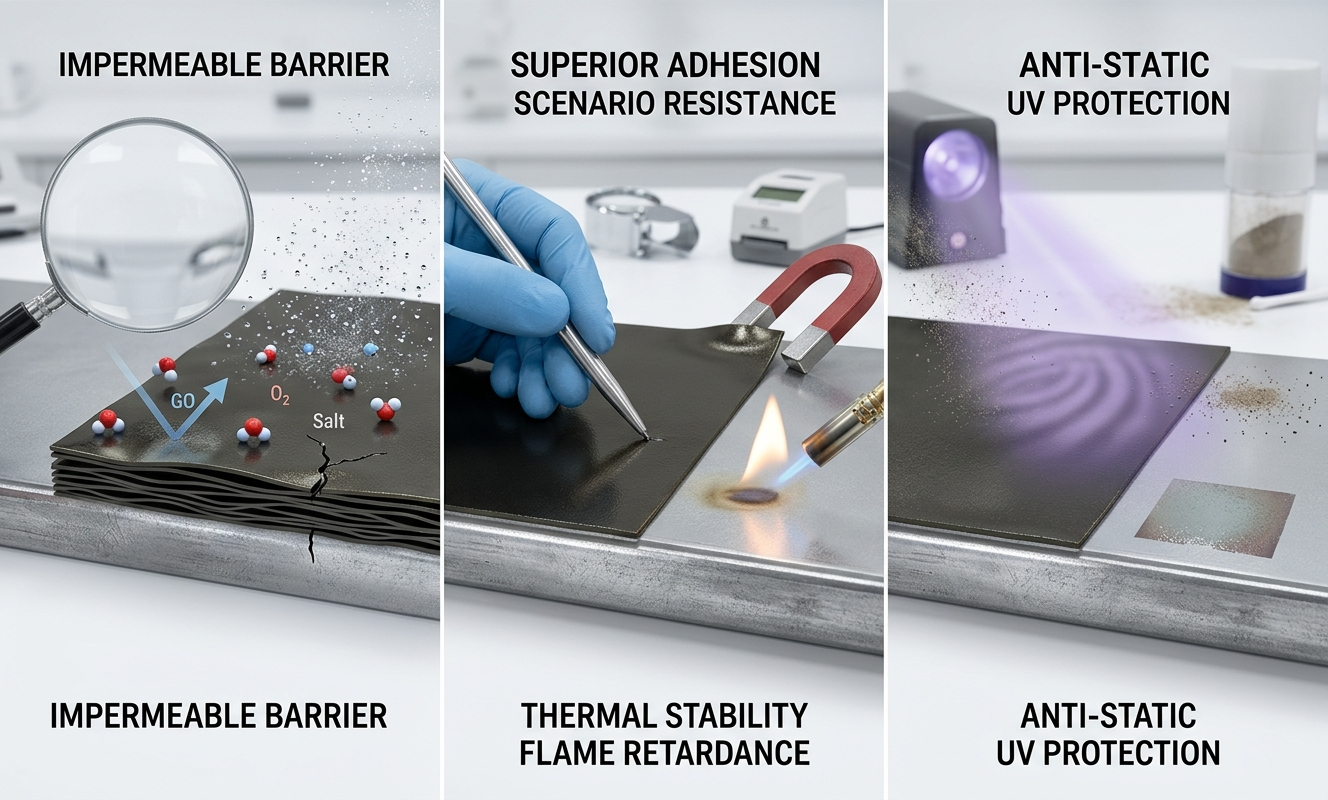
Coatings protect surfaces from corrosion, moisture, chemicals, and wear. However, many traditional systems fail when conditions become harsh or long-term exposure begins to break down the protective layer. Because of this, industries now look for materials that improve performance at the microscopic level rather than simply increasing coating thickness. Graphene oxide (GO) has emerged as a strong solution in this space.
Although advanced carbon materials continue to evolve, GO offers a unique balance of structure and chemistry. Interestingly, while single-layer graphene provides exceptional conductivity and strength, its oxidized form introduces functional groups that improve compatibility with coating systems. This difference makes GO more suitable for protective layers where adhesion, dispersion, and barrier performance are most important.
So, what makes this material ideal for coatings? Let’s explore the key technical reasons behind its effectiveness.
Layered Structure That Strengthens Barrier Protection
The first advantage comes from its layered architecture. Each sheet forms a thin, plate-like structure with a very high aspect ratio. When incorporated into a coating, these sheets align and overlap, creating a dense internal network.
Because of this arrangement, external agents such as water, oxygen, and corrosive chemicals cannot travel in a straight path. Instead, they must navigate a complex, extended route. This structure significantly slows down penetration.
As a result, permeability decreases, and protection improves. Even small additions can create a noticeable barrier effect. The coating becomes more resistant to environmental damage without increasing thickness.
In practical terms, this layered structure transforms a simple coating into a multi-level defense system that blocks harmful substances more effectively.
Surface Chemistry That Improves Adhesion
Graphene oxide contains oxygen-based functional groups such as hydroxyl, epoxy, and carboxyl groups. These groups increase chemical interaction with coating matrices and substrates.
When applied to a surface, the material does not simply sit on top. Instead, it interacts with the matrix at a molecular level. This creates stronger bonds and improves adhesion.
The presence of polar groups also increases surface energy. As a result, the coating spreads more evenly across the substrate. Better wetting increases the contact area, further strengthening the bonding.
In addition, chemical interactions between functional groups and polymer chains create a more integrated interface. This reduces the risk of peeling or delamination under stress.
Uniform Dispersion for Consistent Performance
Dispersion plays a critical role in coating quality. Poor dispersion leads to weak zones, which reduce protection and durability. However, GO disperses well due to its surface chemistry.
Its functional groups interact with polar solvents and polymer systems. This prevents agglomeration and keeps the sheets evenly distributed throughout the coating.
As a result, the coating forms a uniform structure. Every part of the surface receives the same level of protection. This consistency ensures reliable performance under different conditions.
Moreover, stable dispersion allows manufacturers to maintain repeatable results during large-scale production. This makes the material practical for industrial use.
Mechanical Reinforcement at the Micro Level
Coatings often face mechanical stress such as abrasion, impact, and surface deformation. GO improves resistance to these forces by reinforcing the matrix.
Its strong carbon framework increases stiffness and structural integrity. At the same time, its thin sheets distribute stress more evenly across the coating. This leads to:
-
Improved resistance to scratches and wear
-
Reduced formation of microcracks
-
Better durability under repeated stress
Because of this reinforcement, coatings maintain their protective function for a longer period. They do not fail easily under mechanical pressure.
Thermal Stability and Heat Resistance
Temperature changes can weaken coating systems. Expansion and contraction create stress, which leads to cracks and failure over time. GO helps manage these effects.
Its structure allows better heat distribution within the coating. Instead of concentrating heat in one area, it spreads it across the surface.
Because of this:
-
Thermal stress has reduced significantly
-
Coating stability improves under high temperatures
-
Material degradation slows down
Therefore, GO is suitable for coatings exposed to fluctuating or extreme thermal conditions.
Corrosion Resistance Through Multi-Level Protection
Corrosion protection requires more than just a surface barrier. It depends on how well the coating prevents moisture, oxygen, and ions from reaching the substrate. GO enhances corrosion resistance through several mechanisms working together.
-
It creates a dense barrier that slows down penetration
-
It improves adhesion, which prevents coating separation
-
It reduces pathways for electrochemical reactions
Because of this combined effect, corrosion processes slow down significantly. The substrate remains protected for a longer time. It makes the material highly valuable in marine, industrial, and infrastructure applications.
Tunable Properties for Advanced Coating Design
Another important advantage lies in its adaptability. GO can be modified to suit different coating requirements.
By adjusting its functional groups, manufacturers can control compatibility with various matrices. It allows the development of customized coating systems for specific environments.
In addition, chemical modification can improve properties such as hydrophobicity, conductivity, or chemical resistance. This flexibility supports innovation in coating design.
Because of this, graphene oxide works well across a wide range of applications without requiring major formulation changes.
Efficiency at Low Loading Levels
Traditional fillers often require high concentrations to deliver noticeable improvements. It increases weight and can negatively affect coating properties.
Graphene oxide offers better efficiency at low loading levels. Even small amounts create a strong impact due to their high surface area and layered structure.
This leads to:
-
Reduced material usage
-
Maintained coating thickness
-
Improved performance without added weight
Because of this efficiency, it provides a cost-effective solution for high-performance coatings.
Excellent Performance Across Multiple Mechanisms
One of the strongest advantages comes from the way different mechanisms work together. Graphene oxide does not rely on a single property. Instead, it enhances coating performance through multiple effects.
-
Barrier protection reduces permeability.
-
Chemical bonding improves adhesion.
-
Mechanical reinforcement increases durability.
-
Thermal stability maintains performance under heat.
Because these mechanisms act together, the overall improvement becomes much greater than any individual effect.
Long-Term Stability and Crack Resistance
Over time, coatings can degrade due to environmental exposure and mechanical stress. Cracks form, and protective properties weaken.
Its structure distributes stress and blocks crack propagation. When cracks begin to form, they encounter graphene sheets that slow or redirect their growth.
As a result, the coating remains intact for a longer period. GO improves durability and reduces maintenance requirements.
In addition, its barrier properties protect the interface from moisture and chemical attack, which further enhances long-term stability.
Final Thoughts
Graphene oxide stands out as an ideal material for coatings due to its combination of structural and chemical advantages. It strengthens barrier protection, improves adhesion, enhances mechanical durability, and supports thermal stability. At the same time, it offers excellent dispersion and efficiency at low concentrations.
While single-layer graphene provides outstanding electrical performance, GO delivers the surface functionality required for coating systems. This makes it a more practical choice for protective applications.
If you aim to develop coatings that withstand harsh environments, maintain strong adhesion, and deliver long-term performance, GO provides a reliable, advanced solution.

 English
 Arabic
 French
 Portuguese
 Deutsch
 Turkish
 Dutch
Dutch
 Italiano
 Russian
 Romaian
 Portuguese (Brazil)
 Greek
Greek
