


AWG Fire Alarm Cable Ratings
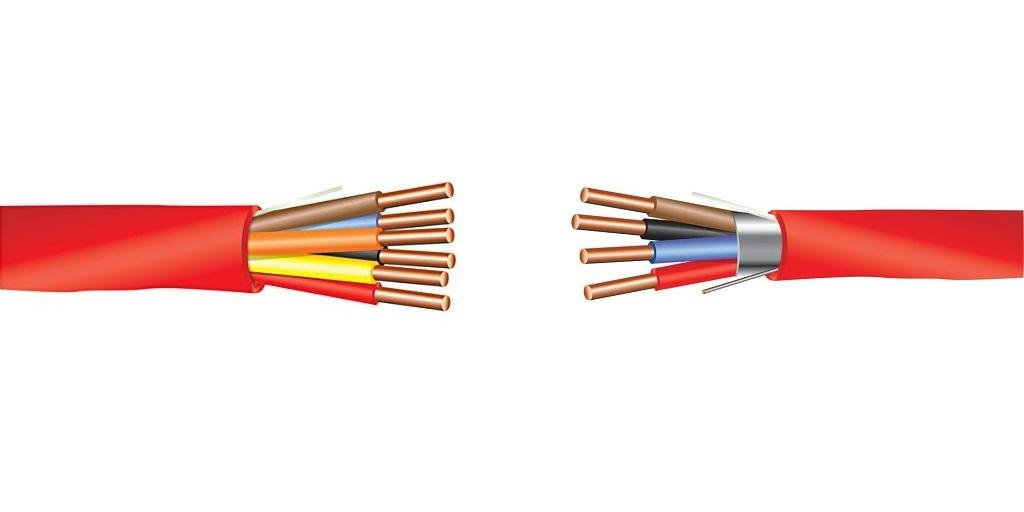
You might think that fire alarm cable is just fire alarm cable, but there is a surprising degree of variability in this microcosmic world of specialty electrical cable for alarm system communication.
This short post will cover some of the common ratings associated with AWG fire alarm cable.
What Is AWG?
AWG, or American Wire Gauge, is not so much a rating as it is a system for measuring the diameter of electrical wire and cable. This post is not going to get into the details of AWG; all you have to know is that a larger number in AWG is a smaller, thinner wire. Therefore, 24 AWG fire alarm cable is thinner than 18 AWG cable.
FPL
FPL fire alarm cable is a general-purpose fire alarm cable; FPL means “fire, power limited” and these cables are used for general installations, but should not be installed in ducts, plenum space, risers, or other areas in which environmental airflow is allowed to pass unchecked.
FPLP
FPLP stands for “fire, power-limited, plenum”, and this class of fire alarm cable is expressly rated for use in plenum space, which is the space above a drop ceiling (or less commonly, below a raised floor) that is usually used for HVAC ductwork and other equipment.
Plenum-rated AWG fire alarm cable is designed to be installed in areas that have a lot of airflow. As a result, they must adhere to stringent requirements for self-extinguishing if they catch fire, and should be made with insulation that produces minimal or no toxic smoke when exposed to a flame, or heated.
FPLR
FPLR stands for “fire, power-limited, riser” and is rated for installation in riser space, which is the vertical space (sometimes called riser closets) that communicates between the floors of a building.
Like plenum-rated cables, they should self-extinguish and produce minimal toxic smoke when they are heated, or even exposed to a flame.
UL 1424
UL 1424 is a standard that all FPL, FPLP, and FPLR AWG fire alarm cables must satisfy. For one, when exposed to heat or flame, the maximum flame propagation distance is 5 feet. That is, the cables must put themselves out if they catch fire. This standard also applies to the smoke’s optical density; the peak optical density must be .5 or less and the average optical density must be .15 or less.
UL 1666
UL 1666 is a standard applied to cables that are intended to be installed in vertical shafts, so in this case this applies to riser-rated fire alarm cables. To satisfy this standard, the cables tested must not allow flames to propagate beyond 12 feet vertically, and the temperature at the top of the shaft in which the cables are contained must not exceed 850℉.
UL 1581
UL 1581 is another standard; this one tests for certain physical, mechanical and chemical properties. To satisfy this requirement, when exposed to a flame, cables must produce little smoke and must be halogen-free, so as not to release harmful chemicals when burning.
Shielded or Non-Shielded
Shielded cables are those that are protected by a metallic shield that helps insulate them against electromagnetic interference. Unshielded cables have no such protection.
Explore AWG Fire Alarm Cables and More
Want to learn more about fire alarm cables, or other security and alarm cable? Visit EWCS Wire and check out their blog which has tons of helpful information.
You can also get high-quality electrical wire and cable, including alarm and instrumentation cable, right through their website. Take a look today and if you have any questions about anything they sell, contact them directly at Sales@EWCSWire.com.
For more information about welding cable and Marine Battery Wire Please visit: Electrical Wire & Cable Specialists.

 English
 Arabic
 French
 Spanish
 Portuguese
 Deutsch
 Turkish
 Dutch
Dutch
 Italiano
 Russian
 Romaian
 Portuguese (Brazil)
