


Why Slip Resistant Disposable Shoe Covers Are a Worker Safety Issue, Not Just a Hygiene One
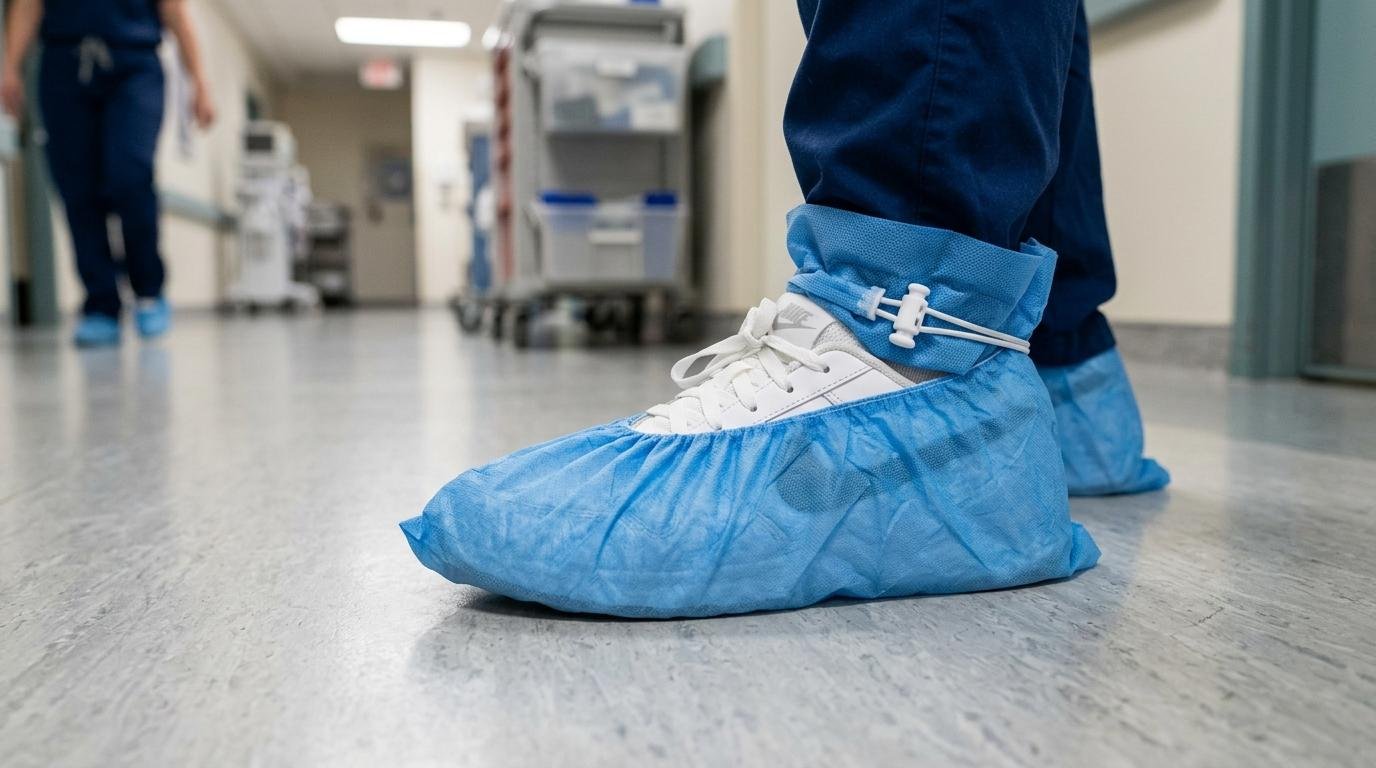
Disposable shoe covers are almost always discussed as a contamination control tool, and rightly so. Floors carry dust, microorganisms, and chemical residue, and shoe covers stop that contamination from travelling between zones. What gets discussed far less often is the slip hazard that a poorly chosen shoe cover actively introduces, turning a hygiene safeguard into a workplace injury risk.
This guide looks at the slip and fall dimension of disposable shoe cover selection specifically, an angle that safety officers and facility managers frequently miss when evaluating shoe covers purely on contamination control criteria.
The Overlooked Tradeoff in Standard Shoe Covers
Most standard polypropylene shoe covers are designed with a smooth sole surface, which is effective for contamination containment but does very little to provide traction on the floor surfaces typically found in hospitals, food production facilities, and pharmaceutical cleanrooms. These environments often combine smooth, polished, or tiled flooring with conditions that introduce moisture, cleaning residue, or spilled liquids on a regular basis.
The result is a shoe cover that solves the contamination problem it was bought for while simultaneously creating a new and entirely separate hazard. A worker wearing a smooth-soled disposable cover on a wet or recently mopped floor faces a measurably higher slip risk than the same worker in their own footwear without a cover at all. Facilities that treat shoe cover selection purely as a hygiene decision are missing this tradeoff entirely.
Where Slip Risk From Shoe Covers Shows Up Most
Hospitals and Clinical Areas
Clinical floors are cleaned frequently, sometimes multiple times per shift, and remain damp for a period afterward. Staff moving quickly between patient rooms, often during time-sensitive situations, are walking on these surfaces in standard shoe covers that were selected for infection control without any consideration of the traction they offer on a freshly mopped floor.
Food Processing and Wet Processing Areas
Food production environments frequently involve standing water, ice, oils, or food residue on the floor as a normal part of operations. A standard shoe cover on this kind of surface creates a slip hazard that compounds with the already elevated risk these environments carry from wet floor conditions in general.
Pharmaceutical Cleanrooms
Cleanroom floors are typically smooth, sealed, and regularly cleaned with solutions that can leave a slightly slick residue. Workers moving through gowning protocols and between production zones in standard shoe covers are navigating this surface multiple times per shift, often while carrying materials or equipment that further reduces their ability to react to an unexpected slip.
Why This Risk Is Easy to Miss in Procurement Decisions
Slip risk from shoe covers tends to be invisible in the procurement process for a simple reason: the decision is usually made by comparing contamination control specifications, material certifications, and bulk pricing across suppliers, none of which directly surface traction performance as a comparison point. A shoe cover that meets every hygiene specification on paper can still be a poor safety choice if its sole offers no meaningful grip.
This gap also tends to stay hidden until an incident occurs. A slip and fall injury involving a disposable shoe cover is rarely investigated with the shoe cover itself as a suspect, since the cover is seen as a hygiene item rather than a safety equipment item. This means the connection between cover selection and slip incidents is frequently never made, even when it is a contributing factor across multiple incidents over time.
What to Look for in Slip Resistant Disposable Shoe Covers
Addressing this gap starts with treating sole traction as a core specification criterion alongside material barrier performance, not as an optional upgrade. Slip resistant shoe covers incorporate a textured or rubberised sole pattern specifically engineered to provide grip on smooth, wet, or polished floor surfaces, addressing the exact conditions where standard covers create risk.
When evaluating slip resistant options, look for a sole pattern with sufficient surface texture depth to channel moisture away from the contact point rather than simply sitting on top of it. Confirm that the slip resistant sole maintains its grip performance across the full range of floor surfaces present in your facility, since a sole tested only on dry tile may behave very differently on a wet, sealed cleanroom floor. Request samples and have workers test them directly on your actual floor surfaces under realistic conditions, including areas that are typically damp or recently cleaned.
Material breathability and fit should not be sacrificed in pursuit of slip resistance. A cover that grips well but fits poorly or causes discomfort over a full shift introduces its own compliance problem, since workers are more likely to remove or improperly wear a cover that is uncomfortable, undoing the contamination control benefit entirely.
Building Slip Resistance Into Your Broader PPE Program
Shoe covers do not exist in isolation. They are typically one item within a broader category of disposable items used in hospitals and similar controlled environments, alongside gowns, gloves, masks, and caps. When reviewing your facility's disposable items list, slip resistance deserves the same explicit line item attention as material certification or AAMI protection level, particularly for any zone where floor conditions are known to be wet, polished, or frequently cleaned.
Facilities with documented slip and fall incident history involving disposable footwear coverage should treat this as a priority review item rather than a minor specification update. The cost of switching to a slip resistant shoe cover is marginal compared to the cost of a workplace injury, the associated incident investigation, and any liability that follows.
Final Thoughts
Disposable shoe covers are a contamination control tool first in most people's minds, and that framing is not wrong, but it is incomplete. The sole of the cover a worker is standing on every step of their shift is also a safety equipment decision, and treating it purely as a hygiene specification misses a real and preventable risk.
Review your current shoe cover specification with traction performance as an explicit criterion, not an afterthought. Test slip resistant options directly on your facility's actual floor conditions, including the wet or recently cleaned surfaces where the risk is highest. A shoe cover that protects against contamination and protects against a fall is a meaningfully better choice than one that only achieves the first.

 English
 Arabic
 French
 Spanish
 Portuguese
 Deutsch
 Dutch
Dutch
 Italiano
 Russian
 Romaian
 Portuguese (Brazil)
 Greek
Greek
