


Clutch Disc Market Dynamics: Assessing the 10.06% CAGR Trajectory in the Context of High-Performance Vehicle Manufacturing (2026–2034)
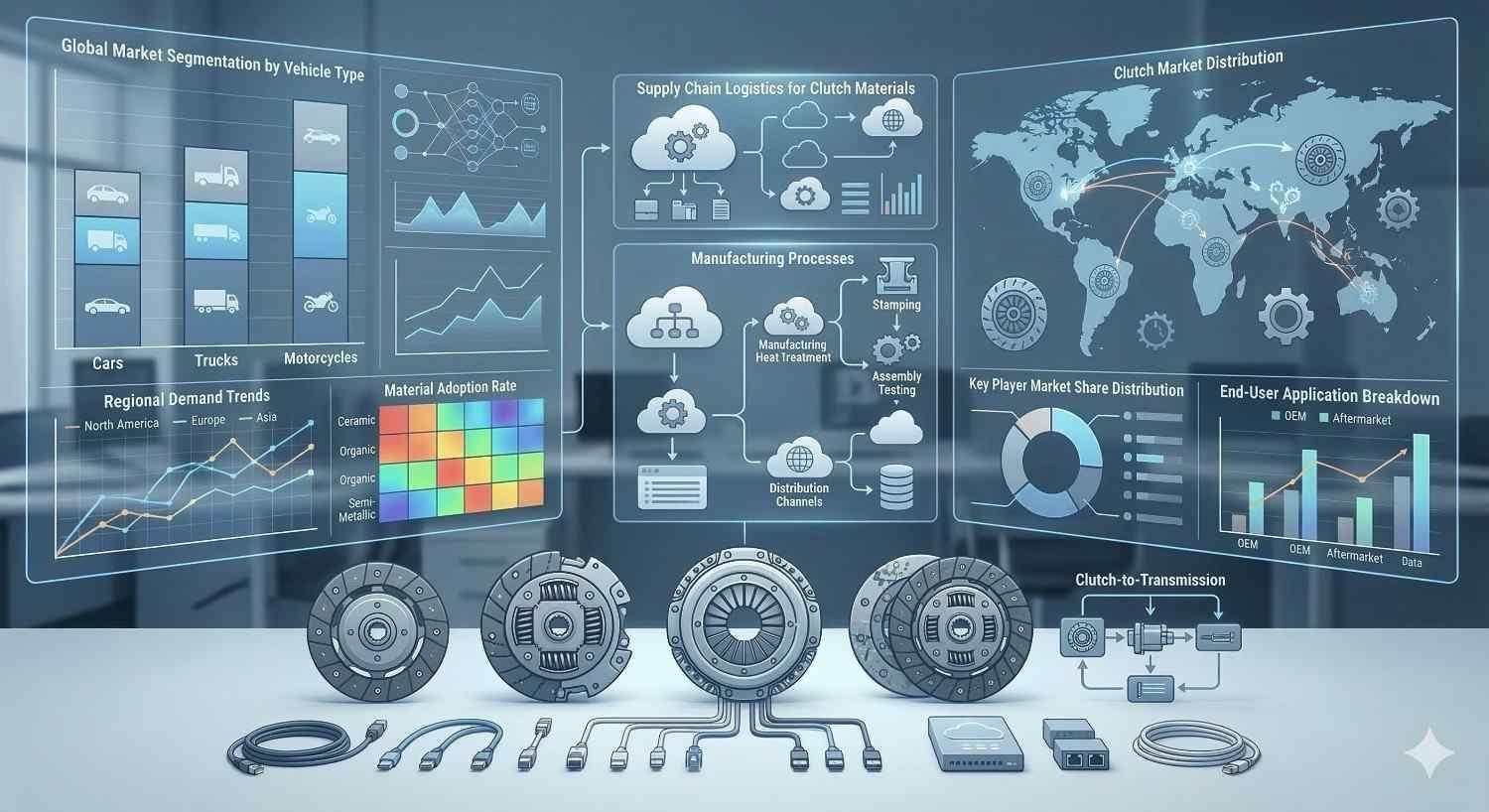
The Friction Point of Motion: A Comprehensive Analysis of the Global Clutch Disc Market
In the intricate dance of mechanical power that moves a vehicle, the clutch disc plays an essential, yet often overlooked, role. It is the critical interface that connects and disconnects the engine’s power to the transmission, enabling us to start, stop, and change gears. According to a detailed report by Facts & Factors, this foundational automotive component is on a robust growth path, projected to increase from USD 17.60 billion in 2025 to USD 36.14 billion by 2034, expanding at a solid compound annual growth rate (CAGR) of 10.06%.
This article provides an in-depth analysis of the global clutch disc market, exploring its key types, applications across vehicle segments, and the trends shaping its future in an era of both continued internal combustion engine (ICE) demand and the rise of electrification.
What is a Clutch Disc?
A clutch disc, also known as a friction disc, is a circular metal plate with friction material bonded to its surfaces. It is sandwiched between the engine’s flywheel and the pressure plate. Its primary function is to transmit engine torque to the transmission input shaft via friction, while also allowing for a smooth, temporary disconnection of power during gear changes. The market is segmented by the material of the friction lining, which dictates its performance characteristics:
-
Organic Clutch Disc (36% Market Share): The dominant type, made from glass and Kevlar fibers bonded with resin. It is prized for its smooth engagement and cost-effectiveness, making it the standard for the vast majority of passenger cars.
-
Ceramic Clutch Disc: Designed for high-performance and heavy-duty applications, offering high heat resistance and the ability to handle extreme torque without fading.
-
Metallic and Kevlar Discs: Niche segments for specific performance and durability needs.
Key Market Drivers: ICE Volume, Emerging Markets, and the Aftermarket
The steady growth of the clutch disc market is fundamentally tied to the continued production and use of internal combustion engine vehicles, particularly in developing economies.
-
Rising Global Vehicle Production in Emerging Economies: This is the single most powerful driver. The massive and growing vehicle production in Asia-Pacific, particularly in China and India, directly fuels OEM demand for clutch discs. Importantly, these markets still heavily favor manual transmissions (65% share) due to their lower cost and perceived fuel efficiency, creating a high-volume, sustained demand for clutch discs. The passenger cars vehicle type segment dominates with 74% , reflecting this volume.
-
The Robust and Recurring Aftermarket: Clutch discs are wear-and-tear items, typically requiring replacement every 60,000 to 100,000 miles. This creates a massive, perpetual, and highly profitable aftermarket for replacement parts, servicing the billions of vehicles already on the road worldwide. This channel provides a stable revenue stream that is less susceptible to the cyclical nature of new car sales.
-
Growth of Light Commercial Vehicles (LCVs) and Logistics: The global boom in e-commerce and last-mile delivery is driving sales of LCVs. These vehicles operate under demanding conditions, causing faster wear on clutch components and increasing the frequency of aftermarket replacements, making this a key growth sub-segment.
Market Segmentation: Organic Discs and Manual Transmissions Lead
The market segmentation clearly illustrates the dominance of cost-effective, smooth-engagement materials and the preferred transmission type in high-volume markets.
By Type: The Reign of Organic Clutch Discs
-
Organic Disc (36% Market Share): This segment’s dominance is a direct result of its “good enough” performance at the right price for the mass market. Its smooth engagement is essential for driver comfort in daily commuting, and its lower cost makes it the default choice for the millions of passenger cars produced each year.
-
Ceramic Disc (28% Market Share): The second-largest segment, driven by heavy-duty commercial vehicles and the performance aftermarket. Its ability to withstand high heat and aggressive use makes it essential for trucks and sports cars.
By Transmission Type: The Primacy of Manual
-
Manual Transmission (65% Market Share): This segment’s overwhelming share is sustained by its deep entrenchment in the world’s largest automotive markets, particularly in Asia-Pacific, Latin America, and parts of Europe. Its mechanical simplicity, lower cost, and ease of repair make it the transmission of choice for a huge global population of car buyers.
-
Automated Manual Transmission (AMT) (20% Market Share): The fastest-growing segment. AMT offers a low-cost “automatic-like” experience, particularly appealing in urban, traffic-congested environments. It still relies on a traditional clutch disc, but with automated actuation, ensuring its relevance as vehicles gain more electronic control.
Regional Landscape: Asia Pacific as the Global Hub
-
Asia Pacific (48% Market Share): The region is the undisputed global leader, serving as both the world’s largest vehicle manufacturing hub and the largest market for manual-transmission vehicles. China and India are the twin engines of this dominance, with massive production volumes and a strong preference for affordable, stick-shift cars. The dense network of local suppliers also provides significant cost advantages.
-
North America: A significant market, but with a key difference: the passenger car market is dominated by automatic transmissions. Demand here is driven primarily by the high volume of light trucks and SUVs, and a very organized and high-value aftermarket.
-
Europe: A mature market with a mix of manual (traditionally strong) and automatic transmissions. Growth is increasingly tied to developing advanced clutch systems for hybrid vehicles and performance applications. Germany is the hub for this high-tech development.
Challenges in the Market
Despite its steady growth, the market navigates significant headwinds, most notably the global shift in propulsion technology.
-
The Accelerating Transition to Electric Vehicles (EVs): This is the most significant long-term challenge. Most modern EVs use a single-speed transmission and do not require a traditional friction clutch. As EV adoption grows, especially in developed markets, the addressable market for new (OEM) clutch discs will face increasing pressure.
-
Raw Material Price Volatility: Clutch disc manufacturing relies on steel, copper, and specialized friction materials. Fluctuations in global commodity prices can significantly impact production costs and squeeze the thin margins typical of high-volume OEM supply.
-
Supply Chain Complexity and Risks: Modern supply chains are global and complex. Disruptions, whether from geopolitical events, trade policies, or pandemics, can impact the sourcing of specialized materials and delay production for automotive OEMs.
Future Opportunities: Hybrids, Advanced Materials, and “E-Clutches”
The future of the clutch disc market lies in adapting to the new automotive landscape and capturing high-value niches.
-
The Rise of Hybrid Powertrains: Hybrid vehicles still require clutches, but often of a different kind. The development of “e-clutches” – electronically controlled modules that seamlessly decouple the engine from the electric motor in hybrids – is a major growth opportunity for innovative suppliers. Honda’s 2025 introduction of its “E-Clutch” technology is a prime example of this trend.
-
Advancements in Material Science: There is a growing opportunity in premium friction materials like carbon-ceramic and Kevlar composites. These offer superior heat resistance and durability for high-performance vehicles and heavy-duty applications, allowing manufacturers to capture higher profit margins in specialty segments.
-
Serving the Aging ICE Fleet Aftermarket: While new EV sales grow, the billions of ICE vehicles already on the road will need replacement parts for decades. The aftermarket for traditional clutch discs will remain a large, stable, and profitable market for the foreseeable future.
Competitive Landscape
The global clutch disc market is dominated by a few large, global Tier-1 automotive suppliers with deep expertise in powertrain technology. Key players include ZF Friedrichshafen AG, Schaeffler AG (LuK), Aisin Seiki Co., Ltd., BorgWarner Inc., and Valeo S.A. These companies compete on engineering excellence, cost, and close integration with automakers’ transmission development programs. Japanese firms like Exedy Corporation and F.C.C. Co., Ltd. are also major global players.
For the full report, detailed data tables, and additional insights, visit: https://www.fnfresearch.com/clutch-disc-market
In conclusion, the global clutch disc market is on a steady growth path, powered by the immense volume of internal combustion engine vehicles produced and driven in emerging economies. While the long-term shift to electrification poses a challenge, the industry’s ability to innovate with hybrid-compatible systems and capitalize on the massive global aftermarket ensures that the “friction point” will remain a vital part of the automotive landscape for many years to come.

 Arabic
 French
 Spanish
 Portuguese
 Deutsch
 Turkish
 Dutch
Dutch
 Italiano
 Russian
 Romaian
 Portuguese (Brazil)
 Greek
Greek
