


The Seax: Europe’s Historic Practical Blade
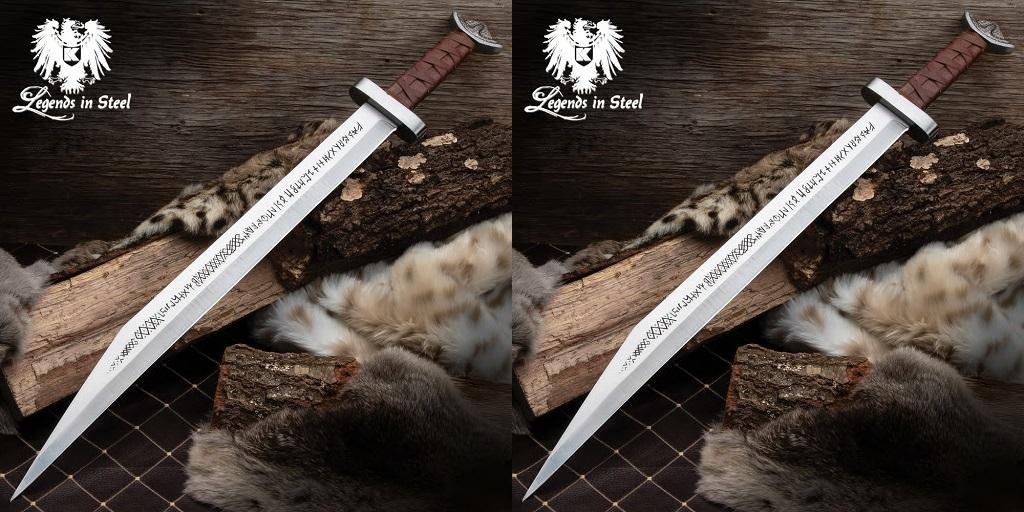
The seax occupies a quietly powerful place in early medieval history: modest in appearance compared with the ornate swords of later knights, it was everywhere in northern Europe from late antiquity through the Viking Age.
Created in an era when iron was scarce and societies were reorganizing after the Roman collapse, the Seax Sword was the everyday blade: a weapon, a tool, and a social signal all at once. That practical hybridity explains both its historical importance and why modern enthusiasts find it so compelling.
The Seax Unique Features
Historically the seax is defined by a few core traits. It’s a single-edged blade, carried at the hip rather than slung for two-handed use, and produced in a wide range of sizes. You’ll find tiny utility blades suitable for carving or food prep, with examples intended for close-quarter combat, and medium forms that functioned as both.
Many seaxes lack a true crossguard, a design choice that favors quick cuts and compact handling but makes thrusting more hazardous. The hand can slide forward on impact without a guard to stop it.
Some later or larger variants do incorporate a simple guard; the distinction between “knife” and “sword” in this family is gradual rather than absolute.
A striking variant often discussed by historians is the so-called broken-back profile: the blade spine takes a sudden change in angle toward the tip. This shape economizes on material, lightening the weapon, and may aid certain cutting and point-centric tasks.
Whether driven by metallurgy, regional preferences, or tactical needs, such morphological variety is typical of the seax’s story: it was adapted to circumstances rather than standardized by courtly fashion.
Functionally, the seax shines for its versatility. It was as likely to be used in slaughtering an animal, whittling a handle, or opening a crate, as it was to be drawn in a raid. Its broad, stout blade transfers a lot of mass into each chop, making it an efficient cutter in the tight melee of coastal raids, village skirmishes, and shipboard fighting.
At the same time, its smaller forms were indispensable for daily chores; a pocket-sized work-knife centuries before the pocketknife became a household staple.
The Culture of the Blade
Culturally, the seax is more than metal and wood. The weapon lent its name to people: the Saxons are said to derive their ethnonym from this blade, underscoring how central the tool was to identity and reputation.
Carrying a well-made Seax Sword signaled readiness and a certain level of means; decorative handles or high-quality materials could mark status, just as sharper or larger blades could suggest combat readiness.
That blend of pragmatism, variety, and symbolism explains the modern fascination. Historical reenactors prize the seax because it is authentic to the lived experience of ordinary people as well as warriors; it’s a tactile entry point into everyday medieval life.
For living-history enthusiasts the seax is useful on camp tasks and convincing on the battlefield, it looks right and it functions. Collectors and historians are drawn to its clear lineage and regional variations: the differences between early Germanic forms, later Viking examples, and insular British finds tell stories about trade, technological diffusion, and changing warfare.
Bladesmiths also love the seax because it’s an elegant canvas for metallurgical skill. Its relatively simple geometry highlights edge geometry, pattern-welding, and finish. A well-forged seax can be both brutally effective and quietly beautiful: a wide blade with a clean taper, horn or wood grip, and a neatly finished leather sheath has an austere aesthetic that appeals to people who prefer function-forward design.
Finally, accessibility matters. Compared with full-length swords, seaxes are cheaper to reproduce, easier to ship and handle, and safer to use in reenactment when edges are rounded. That practicality keeps them popular in demonstrations, study groups, and private collections.
The Seax Sword’s Appeal
The seax’s historical role as a multipurpose companion to daily life and raiding made it indispensable in its time; those same qualities: practicality, variability, and cultural resonance. These make it a blade that tells human stories: of survival, craft, identity, and the ordinary mechanics of living in a violent, uncertain age.
For more information about Shillelagh and Medieval swords Please visit: True Swords.

 English
 Arabic
 French
 Spanish
 Portuguese
 Deutsch
 Turkish
 Dutch
Dutch
 Italiano
 Russian
 Romaian
 Greek
Greek
