A spot resistance welder is one of the most widely used machines in modern manufacturing for fast, clean, and repeatable metal joining. It plays a critical role in industries such as automotive body assembly, appliance manufacturing, electrical enclosures, and sheet metal fabrication.
By applying controlled electric current, pressure, and time, a spot resistance welder creates localized weld nuggets without filler material making it ideal for high-speed production environments.
For OEMs, automation integrators, and factory engineers, understanding this technology is essential for improving production efficiency, weld quality, and long-term cost control.
What Is a Spot Resistance Welder?
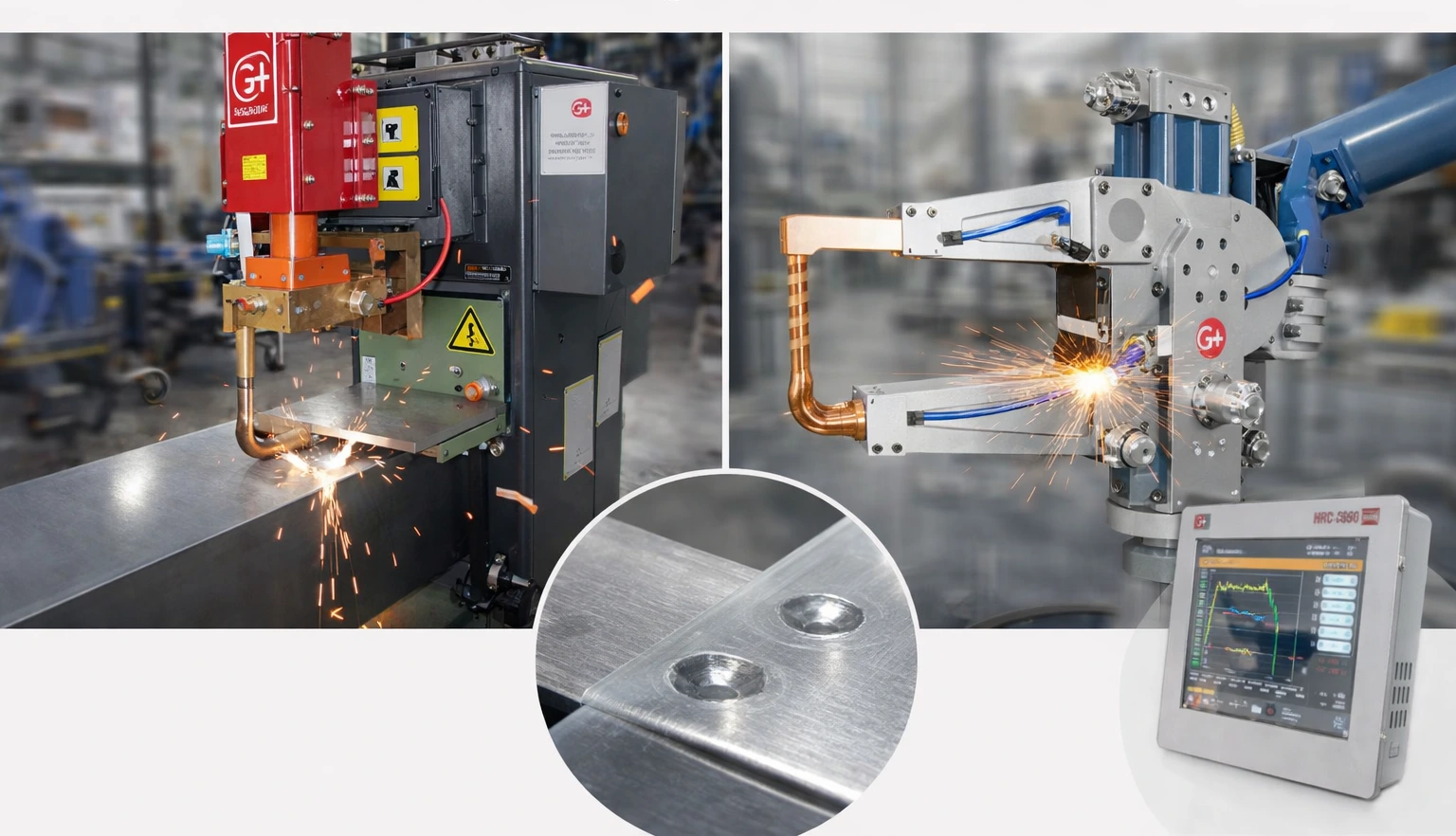
A spot resistance welder is a type of resistance welding machine that joins two or more overlapping metal sheets by passing high electrical current through copper electrodes while applying force.
The heat generated at the interface is due to electrical resistance of the metal, which causes localized melting and fusion of the material. Once cooled under pressure, a strong metallurgical bond is formed.
This process is commonly known as Resistance Spot Welding (RSW) and is considered one of the fastest and most efficient joining methods in mass production environments.
Working Principle of Spot Resistance Welding
The working principle is based on three key factors:
1. Electrical Resistance Heating
When current passes through the metal sheets, resistance at the contact point generates heat. This heat is concentrated at the interface, forming a molten weld nugget.
2. Electrode Pressure
Copper electrodes apply force to ensure good electrical contact and control the shape of the weld spot.
3. Controlled Welding Time
The current is applied for a very short duration, allowing rapid heating and solidification.
These parameters current, pressure, and time must be precisely controlled to achieve consistent weld quality in production lines.
Types of Spot Resistance Welders in Industry
Modern manufacturing uses different configurations depending on automation and production scale:
AC Spot Welders
Traditional systems with simple design and lower cost, commonly used for basic fabrication tasks.
MFDC Spot Welders (Advanced Industrial Standard)
Medium Frequency Direct Current (MFDC) systems provide:
- Faster current response
- Higher energy efficiency
- Stable weld quality
- Better suitability for robotic automation
MFDC technology is now widely preferred in high-end manufacturing environments.
Servo / Pneumatic Spot Welders
- Servo systems offer precise force control
- Pneumatic systems are cost-effective for general production lines
Key Industrial Applications
A spot resistance welder is widely used across multiple sectors:
Automotive Manufacturing
Used for:
- Car body frames
- Doors and panels
- Structural reinforcements
- EV battery structures
Appliance Industry
- Washing machine bodies
- Refrigeration panels
- Air conditioner housings
Electrical & Metal Fabrication
- Cabinets and enclosures
- Busbars and connectors
- Sheet metal assemblies
New Energy Sector
- Battery tabs and packs
- Energy storage systems
- Electrical contact components
Its ability to deliver repeatable high-speed welds makes it indispensable in automated production lines.
Advantages of Spot Resistance Welder
High-Speed Production Capability
A single weld takes milliseconds, making it ideal for mass production environments.
No Filler Material Required
No need for welding rods or flux, reducing cost and complexity.
Clean and Consistent Welds
Produces minimal distortion and clean surface finishes.
Easy Automation Integration
Modern spot resistance welders can be integrated with robotic arms and production lines for continuous operation.
Energy Efficiency (MFDC Systems)
Advanced systems reduce power loss and improve grid stability, lowering overall operating costs.
Challenges and Process Control Factors
Despite its advantages, achieving high-quality spot welds requires precise control of:
- Welding current stability
- Electrode force consistency
- Weld time accuracy
- Electrode wear and maintenance
Poor control can lead to defects such as weak weld nuggets, excessive spatter, or inconsistent joint strength.
Why MFDC Technology Is the Future
Modern factories are rapidly shifting from AC to MFDC-based spot resistance welding because:
- It provides stable DC output
- Reduces welding cycle time
- Improves repeatability in automated systems
- Enhances weld quality on high-strength steels and coated materials
This makes MFDC systems the preferred choice for automotive OEMs and smart factories.
Heron Welder – Engineering Reliable Spot Resistance Solutions
As a global manufacturer of resistance welding technology, Heron Welder specializes in advanced spot resistance welding machines, MFDC systems, projection welding equipment, and fully automated welding lines.
Heron solutions are designed for:
- Automotive structural welding
- High-volume industrial production
- Precision sheet metal joining
- Integrated robotic welding systems
With a strong focus on precision control, automation readiness, and energy efficiency, Heron supports manufacturers in achieving stable production quality and reduced operational cost.
Frequently Asked Questions (FAQs)
1. What materials can a spot resistance welder join?
It is commonly used for mild steel, stainless steel, galvanized steel, and certain aluminum applications with proper parameter control.
2. Is spot welding stronger than traditional welding?
For sheet metal overlap joints in production, spot welding provides highly reliable strength, though it depends on correct parameter settings and design.
3. Can spot resistance welding be automated?
Yes, it is widely used in robotic production lines due to its speed, repeatability, and simplicity.
4. What is the main difference between AC and MFDC spot welders?
MFDC systems offer more stable current, faster welding cycles, and better energy efficiency compared to traditional AC machines.
5. How often should electrodes be replaced?
Electrode life depends on usage, material type, and cooling efficiency, but regular dressing and maintenance are essential for consistent quality.
Conclusion
A spot resistance welder is a core technology in modern industrial manufacturing, enabling fast, clean, and repeatable metal joining for high-volume production. With the rise of automation and lightweight materials, the demand for precise and efficient welding solutions continues to grow.
Advanced systems like MFDC spot welders are setting new standards in quality, efficiency, and integration capability.
Partner with Heron for Advanced Spot Welding Solutions
Heron Welder delivers industry-grade spot resistance welding machines, automation-ready systems, and customized welding solutions tailored to modern manufacturing needs.
Whether you are upgrading a production line or designing a new automated welding system, Heron provides engineering expertise and reliable equipment to support your goals.
Contact Heron today to request a quote or discuss a customized spot welding solution for your factory.




 English
 Arabic
 French
 Spanish
 Portuguese
 Deutsch
 Turkish
 Dutch
Dutch
 Russian
 Romaian
 Portuguese (Brazil)
 Greek
Greek
