


Building Operational Resilience with Lean Six Sigma
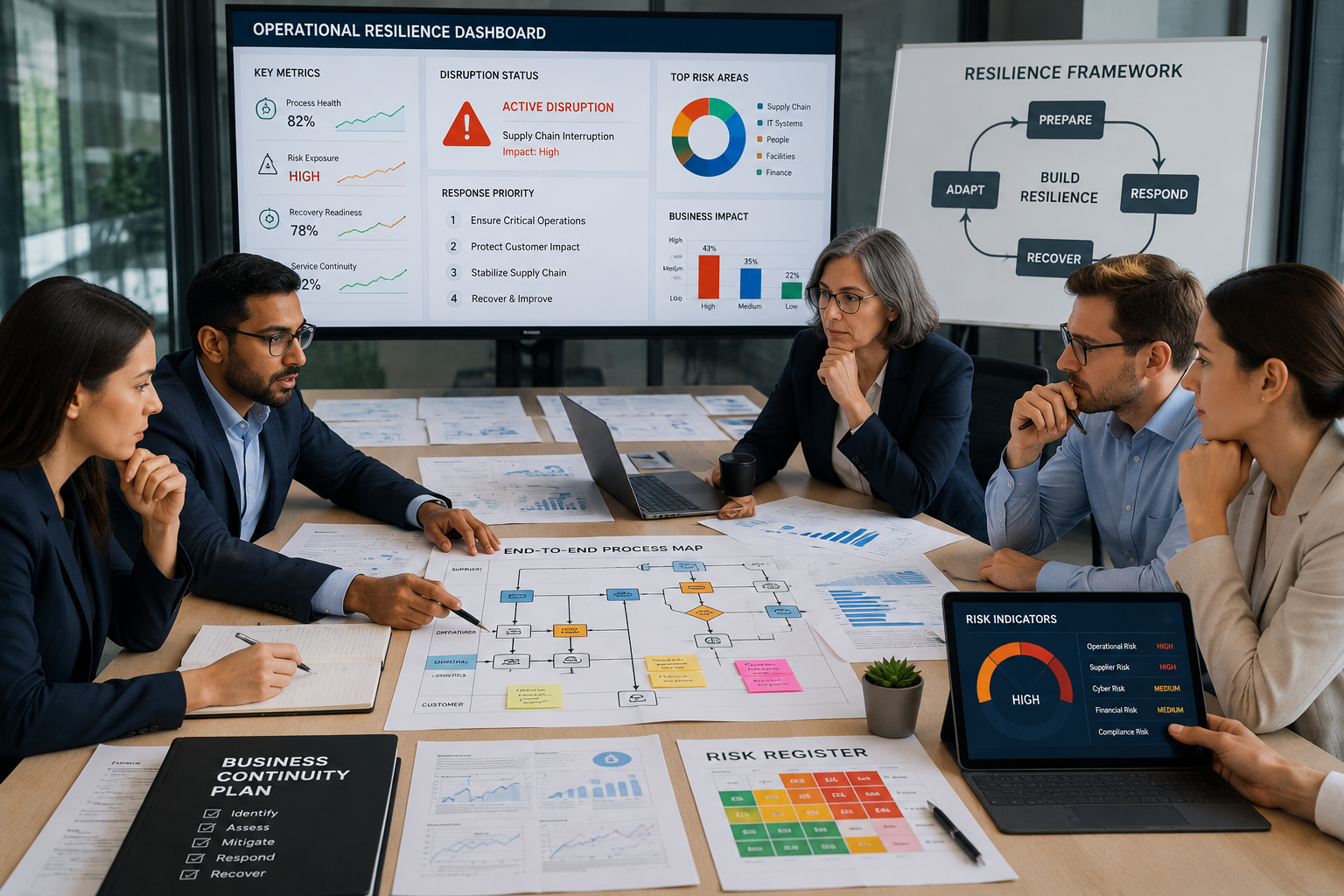
Operational Resilience Through Lean Six Sigma
Introduction
Organizations face a growing number of disruptions. Cybersecurity incidents, supply chain interruptions, workforce shortages, and rapid technology changes can affect daily operations with little warning. As businesses become more connected and dependent on digital systems, maintaining stable performance during unexpected events has become a priority.
Operational resilience focuses on an organization's ability to continue delivering critical products and services during disruptions. Rather than reacting after problems occur, resilient organizations build processes that can withstand, adapt to, and recover from challenges.
One approach that supports operational resilience is Lean Six Sigma. Its methods help organizations identify weaknesses, reduce variability, improve visibility, and strengthen process performance before disruptions occur.
Quick Summary
Operational resilience is the ability to maintain critical business operations during disruptions. Lean Six Sigma supports resilience by reducing process variability, identifying vulnerabilities, improving workflow consistency, and creating systems that can adapt to changing conditions. Together, these practices help organizations maintain performance, recover more quickly, and reduce operational risk.
Why Operational Resilience Has Become a Business Priority
The Impact of Cyber Threats, Supply Chain Instability, and AI-Driven Disruption
Business operations now depend on interconnected systems, global suppliers, cloud platforms, and automated workflows. While these developments improve efficiency, they also increase exposure to disruptions.
Cybersecurity incidents can interrupt operations by affecting critical systems and data access. Supply chain disruptions can delay production and service delivery. Workforce shortages can create gaps in essential processes. At the same time, artificial intelligence introduces new opportunities and operational risks that organizations must manage carefully.
As these challenges grow, resilience becomes an important component of long-term operational stability.
Understanding Operational Resilience
What Operational Resilience Means
Operational resilience refers to the ability of an organization to anticipate, withstand, respond to, and recover from disruptions while maintaining critical functions.
The goal is not to eliminate every risk. Instead, it is to ensure that essential operations continue despite unexpected events.
Resilience vs Business Continuity
Business continuity focuses on plans and procedures that support recovery after a disruption occurs.
Operational resilience takes a broader view. It includes risk management, process design, monitoring, governance, and continuous improvement activities that reduce the impact of disruptions before they occur.
Key Elements of Resilient Business Operations
Key elements often include:
-
Process visibility
-
Risk identification
-
Effective controls
-
Workforce readiness
-
Technology reliability
-
Performance monitoring
-
Continuous improvement
Together, these elements help organizations maintain stability under changing conditions.
Common Threats to Enterprise Stability
Cybersecurity Incidents and System Outages
Cyber attacks, software failures, and network interruptions can affect critical operations. Organizations that rely heavily on digital systems may experience service interruptions, delayed transactions, or loss of operational visibility.
Supplier and Supply Chain Disruptions
Global supply networks create dependencies that can be difficult to manage during unexpected events. Transportation delays, supplier failures, and geopolitical issues can affect production schedules and customer service.
Workforce and Process Dependency Risks
Many organizations depend on specific individuals or teams to perform critical activities. When knowledge is concentrated in a small group, operational risk increases.
Rapid Technology and AI Adoption Challenges
New technologies can improve efficiency but may introduce additional complexity. Organizations must understand how automation, machine learning, and AI-driven processes affect operational stability.
How Lean Six Sigma Strengthens Operational Resilience
Identifying Critical Process Vulnerabilities
Lean Six Sigma emphasizes detailed process analysis. Organizations can map workflows, identify bottlenecks, and uncover hidden weaknesses before disruptions occur.
This visibility allows leaders to focus on areas with the greatest operational impact.
Reducing Process Variability
Variability often increases operational risk. When processes produce inconsistent outcomes, disruptions become more difficult to manage.
Lean Six Sigma tools help reduce variation and improve process predictability, making operations more stable during periods of uncertainty.
Standardizing High-Risk Workflows
Standardized procedures improve consistency and reduce dependence on individual knowledge. Clear documentation also supports faster recovery when disruptions affect personnel or systems.
Building Continuous Improvement Mechanisms
Operational resilience is not a one-time initiative. Continuous improvement practices help organizations identify emerging risks and adjust processes as conditions change.
Designing Disruption-Resistant Workflows
Process Mapping for Risk Identification
Process mapping helps organizations understand workflow dependencies and identify areas where disruptions may have significant consequences.
Eliminating Single Points of Failure
Single points of failure increase operational vulnerability. Resilient organizations identify critical dependencies and develop alternative methods to maintain operations.
Creating Redundant Process Controls
Backup systems, cross-training programs, and secondary suppliers can help reduce operational exposure when disruptions occur.
Improving Workflow Recovery Capabilities
Well-designed workflows support faster recovery by providing clear procedures, escalation paths, and recovery actions.
Supporting Operational Continuity Through Structured Risk Management
Critical Process Prioritization
Not every process has the same operational impact. Organizations should identify critical activities that directly support customers, compliance requirements, and revenue generation.
Scenario-Based Risk Planning
Scenario planning helps organizations evaluate potential disruptions and prepare practical response strategies.
Performance Monitoring and Early Warning Indicators
Monitoring key indicators can help organizations detect risks before they develop into larger operational problems.
Continuity Governance and Accountability
Clear responsibilities improve coordination during disruptions. Governance structures help ensure resilience activities remain aligned with organizational objectives.
Building Resilient Business Operations in an AI-Driven Environment
Managing AI-Related Operational Risks
AI systems can improve efficiency but may introduce concerns related to data quality, model reliability, and decision transparency.
Organizations should evaluate how AI affects critical business processes.
Human Oversight and Process Controls
Human oversight remains important when automated systems support operational decisions. Effective controls help reduce the likelihood of unintended outcomes.
Balancing Automation with Operational Stability
Organizations should balance efficiency gains with resilience objectives. Excessive dependence on automation may increase vulnerability during system failures.
Continuous Risk Assessment and Adaptation
Operational environments continue to evolve. Regular risk assessments help organizations adapt resilience strategies as technologies and threats change.
Measuring Operational Resilience Performance
Recovery Time Metrics
Recovery time measures how quickly operations return to normal after a disruption.
Process Reliability Indicators
Reliability metrics help organizations evaluate process consistency and performance stability.
Operational Risk Exposure Metrics
Risk exposure indicators measure the potential impact of operational threats on critical business functions.
Continuity Readiness Assessments
Regular assessments help determine whether continuity plans, controls, and recovery capabilities remain effective.
Conclusion
Operational resilience has become an essential part of modern business operations. Organizations face increasing challenges from cyber threats, supply chain disruptions, workforce dependencies, and rapidly evolving technologies.
Lean Six Sigma supports resilience by improving process visibility, reducing variability, strengthening controls, and encouraging continuous improvement. These capabilities help organizations maintain performance during disruptions while supporting long-term operational stability.
Businesses that integrate resilience into process design are often better positioned to respond to change, manage uncertainty, and protect critical operations.
FAQs
What is operational resilience through Lean Six Sigma?
Operational resilience through Lean Six Sigma involves using process improvement methods to strengthen an organization's ability to maintain performance during disruptions.
How does Lean Six Sigma improve business continuity?
It improves process consistency, reduces operational risk, identifies vulnerabilities, and supports faster recovery capabilities.
What are disruption-resistant workflows?
These are workflows designed to continue functioning effectively during unexpected events through controls, redundancy, and clear recovery procedures.
How can organizations prepare for AI-driven operational disruption?
Organizations can prepare by implementing governance controls, monitoring AI systems, maintaining human oversight, and conducting regular risk assessments.
Why is enterprise continuity optimization important for modern businesses?
It helps organizations maintain critical operations, reduce operational risk, and improve recovery capabilities during disruptions.
What metrics should be used to measure operational resilience?
Common metrics include recovery time, process reliability, operational risk exposure, and continuity readiness assessments.
One approach that supports operational resilience is Lean Six Sigma Its methods help organizations identify weaknesses, reduce variability, improve visibility, and strengthen process performance before disruptions occur.

 Arabic
 French
 Spanish
 Portuguese
 Deutsch
 Turkish
 Dutch
Dutch
 Italiano
 Russian
 Romaian
 Portuguese (Brazil)
 Greek
Greek
